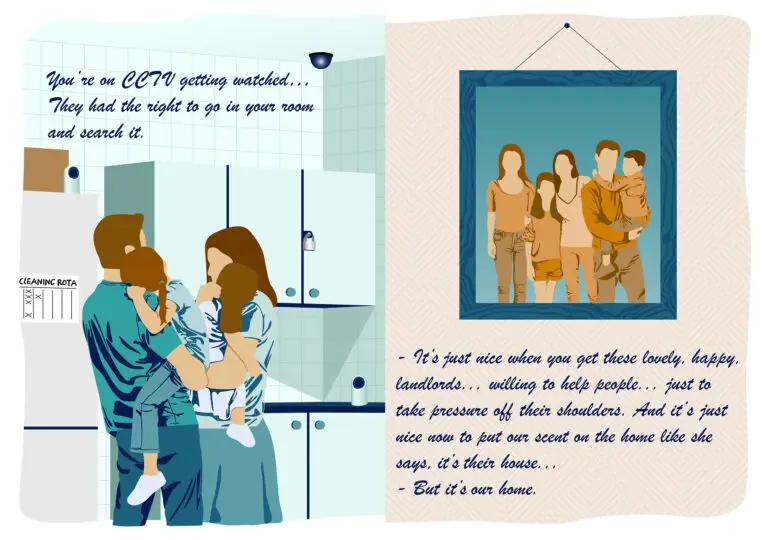
“From a landlord that used to go through all my drawers … to a landlord trying to blow me up, because he reversed the gas meter.”
In contrast, the relationship with her current landlord has helped to the make the property a home.
“She’s superb … very fair. Only rents to locals. Very fair rent.”
“My landlady says, I hope you’re home for life.”
The relationship is built on mutual respect and informal negotiation.
“I had a brainwave … if she paid for [new heaters] then we would agree to up the rent… And she agreed to that.”
The cottage is a Grade II listed rural property with limited insulation and is difficult to heat. It is very isolated, located in a hamlet with no bus service and there are steps down to the cottage which is on two floors. The couple have suffered with respiratory conditions and have increasingly serious mobility concerns. Despite this, the cottage is most certainly considered to be a home.
“Everything about where you live, where it’s actually situated. The property still fills me with warmth. I love it as a property. So the hardships of living there, you overcome because it just works for me.”
They have made their own, limited adaptations, including to get around the difficulties posed by the toilet being on the ground floor.
“We did overcome the downstairs loo bit by putting a porta-loo upstairs … works brilliantly.”
More major adaptations may be unfeasible, for example, it is unlikely that a stairlift would be an option because of the design of the staircase.
“Definitely cottage stairs – go exactly round on yourselves – tight!”
The tenant is conscious that the property characteristics mean they may have to contemplate moving at some point. However, the rural setting makes a positive contribution to her mental and physical health.
“The purity of the air certainly makes a difference.”
The thought of having to move, even to a nearby market town, presents a threat to her identity and the feeling of wellbeing that comes from her home and its setting. Though at times maintaining the garden can be a struggle, being able to spend time in it can have other, significant benefits.